Next webinar | Meetings: Edit Your Meetings Like an Expert


Recurring Meetings: How to Structure Them for Clarity and Value
There’s a special kind of dread that comes with a recurring meeting invite.
It’s always there, every Tuesday at 10, or even worse, every Friday at 3, clogging up your calendar. People join out of habit. Cameras off. Agenda optional. And somewhere between the first status update and the fifth half-decision, you realize: this meeting isn’t helping anyone. It’s just... happening.
A lot of recurring meetings were meant to create structure. Instead, they often create inertia. Same attendees, same talking points, same outcomes (or lack thereof). Over time, they stop being useful and start being background noise.
But here’s the thing: it’s not the recurrence that’s the problem. It’s the lack of structure. And when you fix that, you stop wasting time and start making it count. In this post, we’ll walk through how to redesign your recurring meetings to create real clarity and value, so people leave with direction, not déjà vu.
The Compounding Cost of Poorly Run Recurring Meetings
One bad meeting wastes time. A recurring one builds a culture of wasted time.
It’s not just an hour lost every week. It’s five people spending one hour each, every single week, often just to rehash the same updates or decisions that never landed. Multiply that across a month, then across multiple teams, and you’re suddenly burning dozens of hours on meetings no one finds valuable.
And that’s just the obvious part.
Poorly structured recurring meetings come with hidden costs:
- Delayed decisions - when ownership isn’t clear, decisions get deferred.
- Lost accountability - if follow-ups aren't tracked, nothing moves forward.
- Fragmented focus - context switching and repeated discussions drain attention.
- Participation theater - people show up, but mentally check out.
Over time, these meetings start functioning as placeholders rather than progress points. And because they’re recurring, they rarely get reevaluated. The longer they stay broken, the more time, trust, and attention they quietly erode.
The worst part? Teams often feel this happening, but don’t know how to fix it. So the meetings stay. And the drain continues.
Signs Your Recurring Meeting Is Broken
You don’t need a survey to know when a recurring meeting is off the rails. You can feel it. But just in case you’re on the fence, here are the most common red flags:
- There’s no real agenda. Maybe there was one once, but now it’s just bullet points copied forward, or nothing at all.
- It’s the same conversation every time. No progress, just recycled talking points.
- A few people dominate, others stay silent. It’s unclear who’s supposed to speak, so only the loudest voices fill the gap.
- People multitask or don’t show up at all. Engagement drops when the meeting stops delivering value.
- Nothing gets documented. Decisions, context, and action items vanish the moment the call ends.
- Everyone leaves with a different interpretation of what just happened. No shared record means no shared understanding.
When even the organizer doesn’t look forward to the meeting, that’s a signal. Recurring meetings aren’t passive calendar events. If they aren’t driving alignment, clarity, or momentum, they’re just slowly draining it.
What a Structured Recurring Meeting Should Look Like
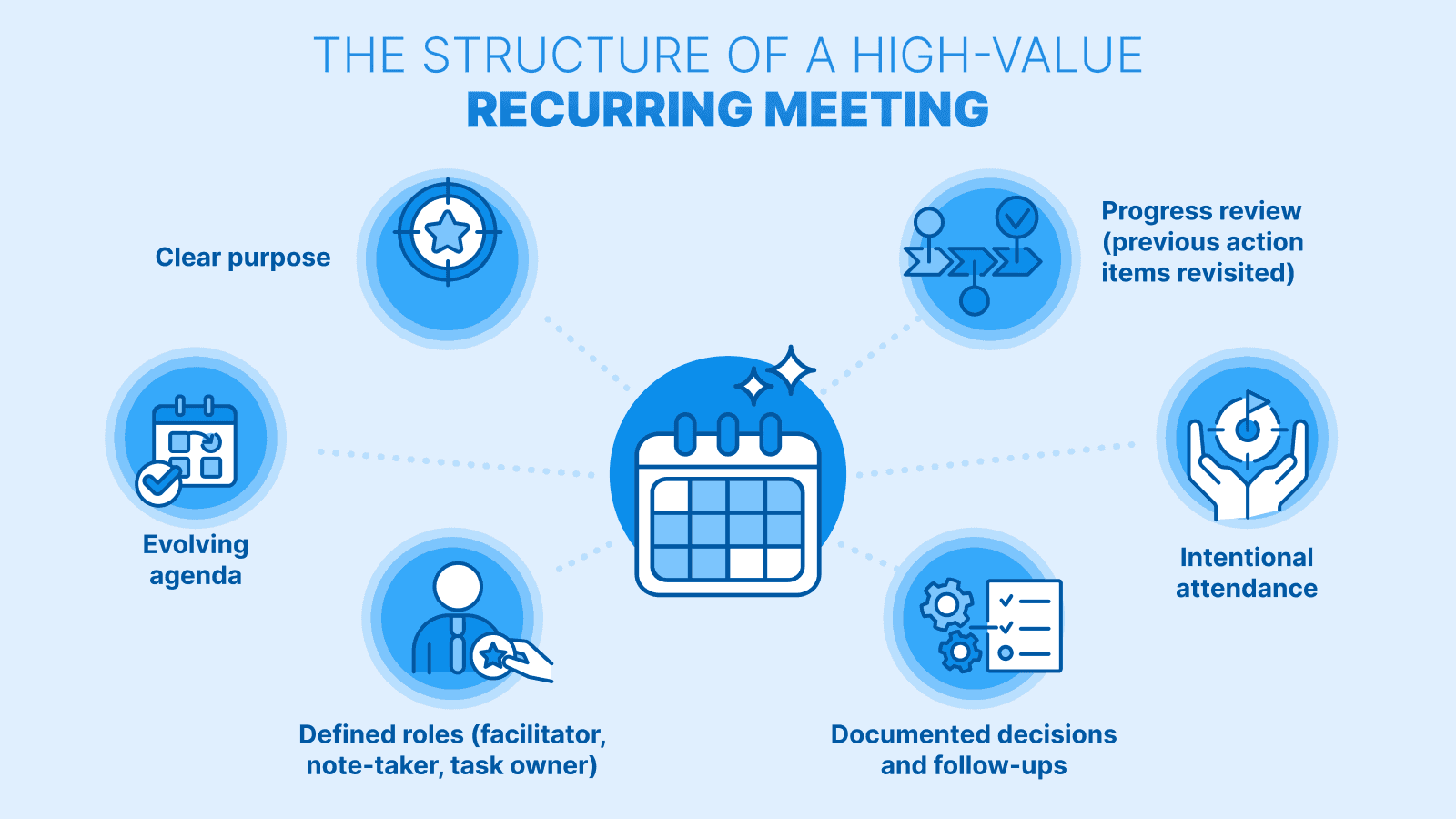
Not every recurring meeting is a lost cause. The good ones do exist, and they don’t happen by accident. Here’s what separates a structured, high-value recurring meeting from the kind people join out of obligation:
- There’s a clear purpose. Everyone knows why this meeting exists, whether it’s to resolve blockers, review key metrics, or make decisions. If the purpose changes, the format changes with it.
- The agenda evolves. It’s not a static checklist. It’s built in advance, focused on outcomes, and time-boxed. New topics are added intentionally, not out of panic or filler.
- Roles are defined. Someone’s leading the discussion. Someone’s capturing notes. Someone’s accountable for follow-ups. If no one owns it, it won’t get done.
- Progress is reviewed. Last week’s action items don’t disappear into the void. They show up again, visibly, until they’re done or resolved.
- Attendance is intentional. If someone doesn’t need to be there, they don’t get dragged into the call. Relevance drives participation, not habit.
When a recurring meeting is structured this way, it stops being a placeholder and starts becoming a lever for progress. It helps people show up prepared, stay engaged, and leave with clarity, not confusion.
How to Fix a Broken Recurring Meeting
If your recurring meeting feels off, it probably is.
And like most of us, you probably don’t want to keep pulling people into a meeting that isn’t helping anyone move forward.
However, you don’t need to overhaul your calendar or reinvent how your team works. A few thoughtful changes can make a big difference, bringing structure, purpose, and energy back into the rhythm.
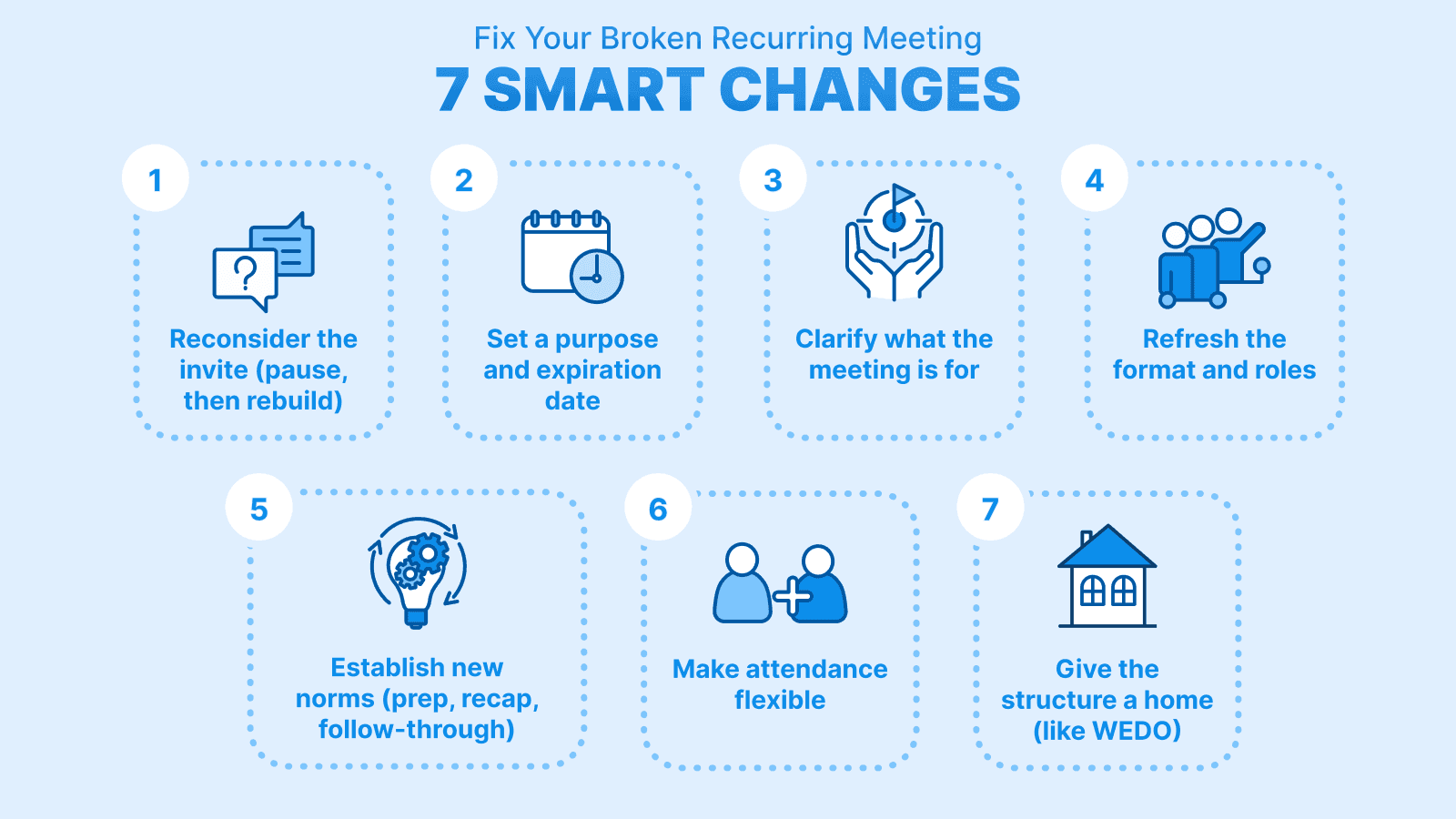
Here’s where to start.
Reconsider the standing invite
Sometimes the most helpful thing you can do is hit pause.
Cancelling a recurring meeting, at least temporarily, can create space to rethink its purpose. You’re not removing it out of frustration. You’re making room to rebuild it with the right intent.
This also signals to the team that their time matters, and that the meeting will come back stronger, not just… back.
Set a purpose and an end date
Not all recurring meetings need to last forever. In fact, most shouldn’t.
If a meeting exists to help move a project forward, consider setting a natural expiration point. You can always restart it later if it’s still needed. But adding an end date gives everyone a reason to focus, make decisions, and avoid dragging things out just to fill the time slot.
And if the meeting’s purpose can’t be clearly defined in one sentence? That’s a sign to rethink it entirely.
Get clear on what the meeting is for
Vague goals lead to vague meetings.
Before restarting the series, take a moment to clarify what a successful version of this meeting would look like. Is it meant to surface blockers? Make decisions? Align on progress?
If you can define the purpose clearly, the rest, agenda, frequency, attendees, gets much easier to shape.
Refresh the format so it works for the team (not just the calendar)
If your current format feels flat, it probably hasn’t been updated in a while. Look at what’s missing:
- Are the same few people speaking while others check out?
- Are action items getting lost after the call ends?
- Does the meeting feel disconnected from what’s actually happening week to week?
Now’s the time to make the structure work harder:
A dynamic agenda, a few defined roles, and a consistent way to track outcomes can go a long way.
Set new norms for how the meeting runs
As the format changes, so should the expectations.
It helps to say them out loud, or better yet, write them down. Things like:
- “Add topics to the agenda before the meeting”
- “Use the first few minutes to review open action items”
- “End with a recap of who’s doing what”
You’re not making it rigid, you’re making it clear. And that clarity gives people a reason to stay engaged.
Make attendance flexible
Not every meeting needs to be a full house. If only three people are actively working through a handoff or decision, everyone else can sit it out.
Encourage people to attend when it’s relevant, not just because their name is on the invite. That shift alone can turn a meeting from a time sink into a focused working session.
Give the structure somewhere to live
It’s tough to keep a recurring meeting useful if the details are scattered across inboxes, chat threads, and documents.
When your meeting prep, discussion, and follow-ups are all in different places, things slip. And people lose track, not because they don’t care, but because they don’t have visibility.
That’s why having a centralized tool matters. One place for agendas, notes, and action items. One place to stay aligned.
Revisit the structure regularly
Fixing a recurring meeting isn’t a one-time task, it’s a habit. Once you’ve got the structure working, set a reminder to check in on it every few months. Is the agenda still relevant? Are action items getting done? Has the purpose shifted? Small course corrections over time can keep the meeting sharp and valuable, instead of slowly drifting back into autopilot.
Why WEDO Makes Recurring Meetings Work
Let’s face it, recurring meetings aren’t going away. And honestly, they shouldn’t. When they’re structured well, they can keep teams aligned, accountable, and moving forward without the daily scramble. The problem is the lack of visibility, ownership, and follow-through.
WEDO gives recurring meetings the infrastructure they’ve been missing:
- Shared agendas that evolve week to week
- Real-time note taking so nothing slips through
- Automatic follow-up tracking
- Integrated task management that connects discussion to action
- One space for context, decisions, and accountability, before, during, and after the meeting
No more toggling between docs, inboxes, and sticky notes. No more repeating the same update three weeks in a row. With WEDO, your recurring meetings don’t just feel better. They actually work better.
Ready to make your recurring meetings worth everyone’s time? Try WEDO for free today and see what structured meetings can actually do for your team.





Struggling to Stay Organized?
WEDO is here to help. Start your free trial now and simplify your work processes! You'll get full access to all features and add-ons for 14 days – invite your team to test it with you!