Next webinar | Ditch the Spreadsheets: Bring Everyone Together and Streamline Your Activities!

The ROI of Improving Meeting Effectiveness in Your Organization
Let’s talk about the most expensive room in your office. It’s not the server room. No, it’s not the CEO’s corner office either. It’s the conference room (or the Zoom room).
Let’s take a look at the statistics: The average executive spends 23 hours a week in meetings. That is more than half of their working life. And still, studies show that nearly 50% of those meetings are considered a waste of time.
The financial damage doesn't stop when the meeting ends. There is a phenomenon known as "meeting recovery syndrome." The mental exhaustion that employees feel after a poorly run, unproductive meeting. They don't just go back to their desks and start working. They vent to colleagues, stare at the screen to reset their focus, or simply, procrastinate.
For too long, organizations have treated meeting effectiveness as a ‘soft skill’ or a cultural issue. They assume that bad meetings are just a fact of corporate life, like bad coffee or traffic.
This is a mistake.
Meeting effectiveness is a measurable financial lever. When you optimize your meetings, you are unlocking a return on investment (ROI) that impacts three phases: how you prepare, how you execute, and how you follow up.
Time is Money: Calculating the Hard Costs
Let’s skip the corporate buzzwords and look at the math.
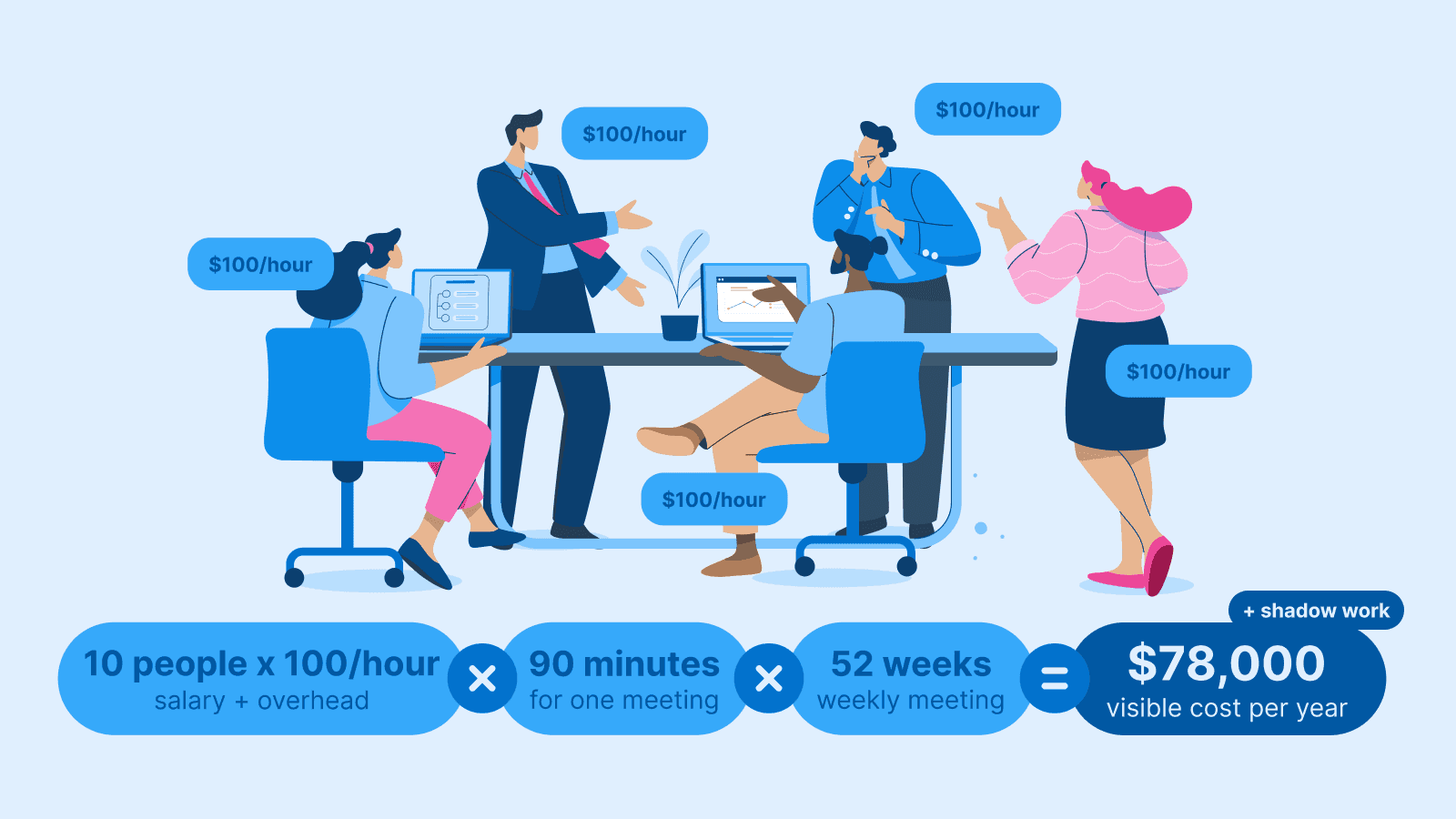
Imagine a standard weekly status meeting. You have 10 participants. Let’s assume an average ‘burdened’ hourly rate (salary + overhead) of $100 per person.
- 10 people x $100/hour = $1,000 per hour.
- If that meeting runs for 90 minutes, you have just spent $1,500.
- If you hold that meeting weekly, that is $78,000 a year, spent on one single meeting.
Now, ask yourself: Did that 90-minute session produce $1,500 worth of value? Did it contribute to completing a project? Or was it just a bunch of updates that could’ve been an email?
Every hour your team spends in a vague ‘catch-up’ session is an hour not spent on strategic growth, billable client projects, or product development. This is the visible cost.
But there is also the "shadow work" of meetings. The hours spent hunting for old minutes in shared drives. It’s the EAs chasing executives for updates. It’s the manual typing of notes from a notebook into a Word doc. Studies suggest that knowledge workers spend up to 20% of their workweek just searching for information. By centralizing your meeting documentation and tasks, you hand your team back one full day of productivity every week.
The Soft ROI of Accountability and Transparency
While hard costs are easy to calculate, the "soft ROI" often has a bigger impact on your company’s long-term health.
How often have you heard (or asked) the question: "Wait, didn't we decide that last time?"
That sentence is the sound of money burning. When decisions are forgotten, projects stall. There is immense value in structured agendas where everyone can contribute. When employees are allowed to add items to an agenda, they feel invested. This reduces the feeling of helplessness that leads to burnout.
For Boards and Executive Committees, the ROI is found in security and governance. In high-stakes environments, "talk" needs to become "law." You cannot rely on a loose email thread to confirm a budget increase or a merger strategy. Using tools that offer digital voting and electronic signatures turns a discussion into a binding record. You can securely lock minutes, request signatures, and archive the decision legally. The ROI here is risk mitigation, ensuring that your governance is bulletproof.
The Three Pillars of Meeting Effectiveness
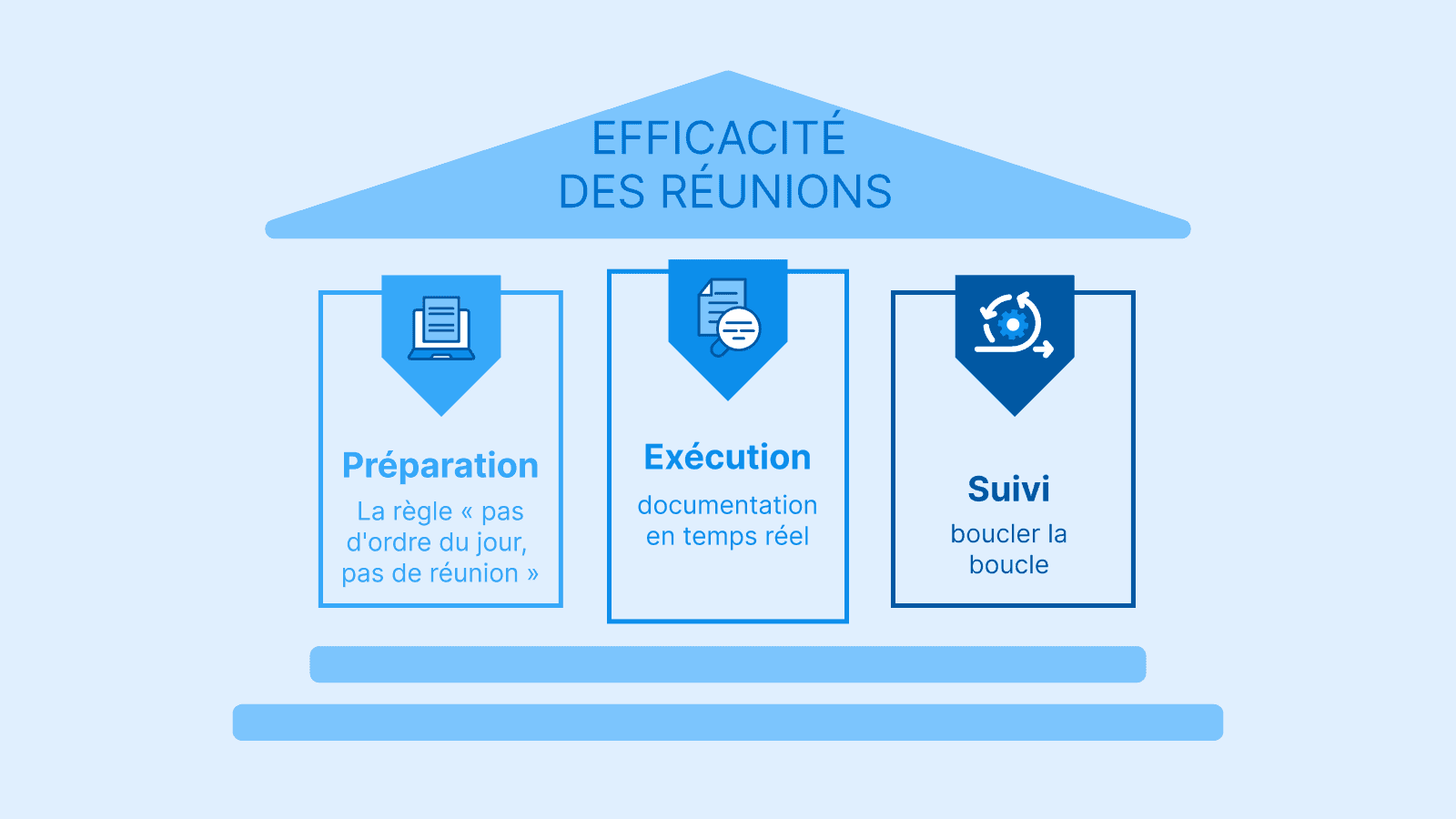
To capture this ROI, you cannot just ‘try harder.’ You need a system built on pillars.
1. Preparation (The "No Agenda, No Meeting" Rule)
The most productive meetings happen before the meeting starts. If there is no agenda, there is no meeting. Period! But a static agenda isn't enough. You need shared agendas with attached files. If the financial report is attached to the agenda item, participants read it beforehand. This allows the meeting to be about deciding on the numbers, not reading them. This shift alone can cut meeting times by 30%.
2. Execution (Real-Time Documentation)
The ‘transcription lag’ is the enemy of momentum. In a high-ROI meeting, the minutes are written live. Using a dedicated platform allows for real-time note-taking. By explicitly defining a strict duration for each agenda item, you establish a formal framework that keeps the discussion on track.. You walk out of the room with the minutes 95% complete, eliminating the post-meeting administrative hangover. AI is further transforming the landscape: thanks to the transcription of recordings, taking notes is now seamless. Certain tools can even synthesize discussions directly to highlight the most important points. This saves the note-taker a considerable amount of time and guarantees that all critical decisions are accurately captured.
3. Follow-up (Closing the Loop)
This is where the money is made. A meeting without action is just empty words. You must create a "task-meeting link." When a task is assigned during the meeting within your platform (like WEDO), it is linked directly to the discussion point. You can click on a task and see exactly why it was assigned and what the context was. This context prevents tasks from slipping through the cracks and ensures that "to-dos" actually get "done."
Use Cases for High-Stake ROI
Improving meeting effectiveness isn't one-size-fits-all. It looks different across the organization.
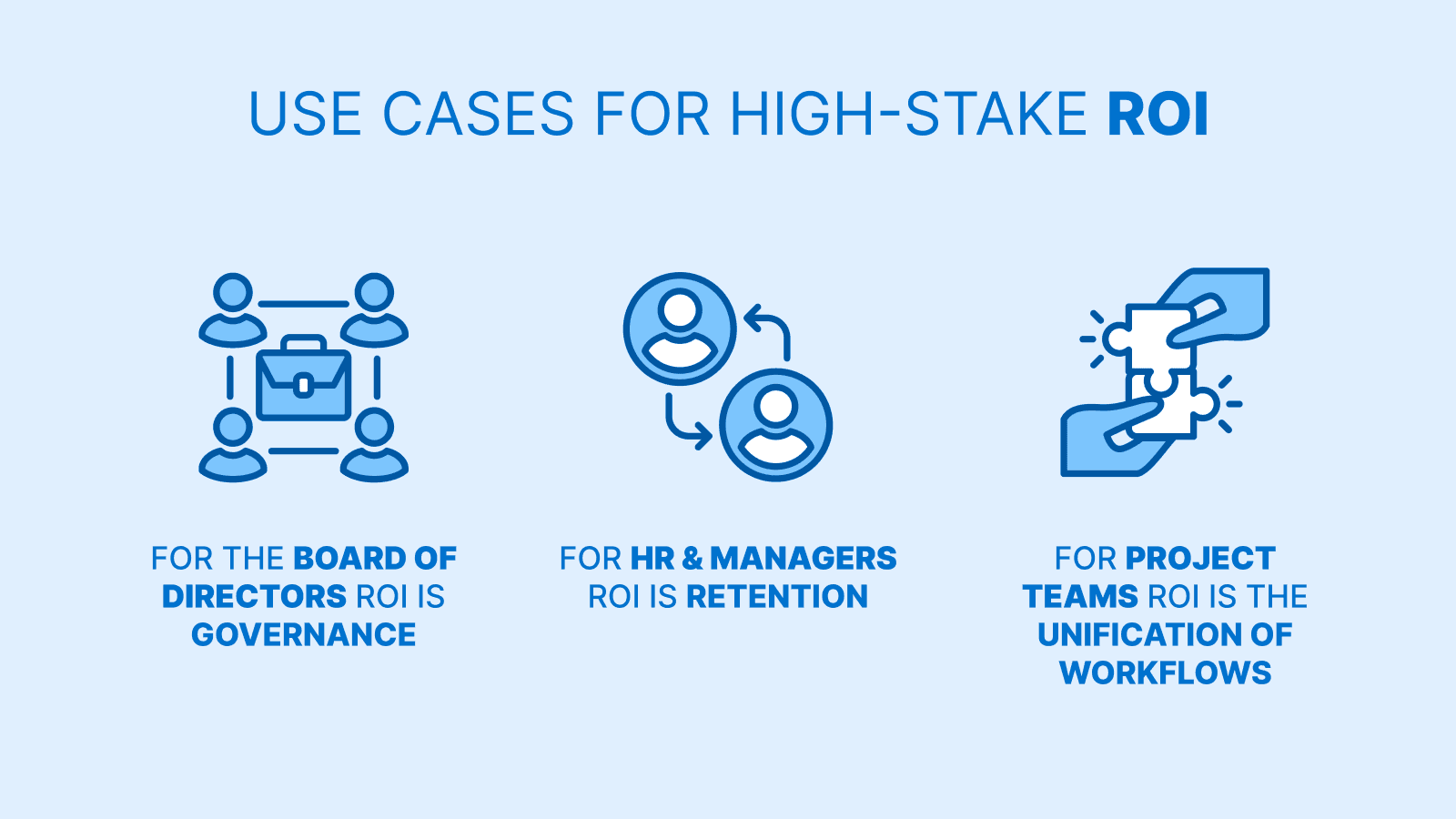
- For the Board of Directors: The ROI is governance. Boards need a secure environment where sensitive documents are encrypted, and minutes are legally signed. The efficiency comes from streamlined board packs and the ability to audit decisions years later instantly.
- For HR & Managers: The ROI is retention. One-on-one meetings are often treated as box-ticking exercises. But when structured correctly, they become engines for employee development. A clear history of previous discussions shows the employee that their growth is being tracked and valued.
- For project teams: The ROI is the unification of workflows. Rather than scattering information across a task manager, a calendar, and a messaging app, the real value comes from using a single tool that links meeting follow-ups to the resulting actions. By centralizing documents, processes, and tasks within their original context, you eliminate confusion and the time wasted searching for information. This approach ensures that teams (whether remote or hybrid) have all the necessary project elements in one place for an uninterrupted execution.
Conclusion: From Cost Center to Growth Engine
It is time to reframe how we view meetings. For decades, meetings have been viewed as a necessary evil, a "cost center" that drains resources. But when managed correctly, meetings transform into a growth engine. Effective meetings aren't about having fewer meetings (though that often happens naturally). They are about making sure that every single meeting leads to action. Organizations that master meeting management see faster project delivery, clearer communication, and significantly higher employee satisfaction.
You invest in your sales software. You invest in your marketing tools. Why are you not investing in the one activity that consumes 50% of your executive time?
Ready to reclaim your organization's time and stop the financial leak? Try WEDO for free today.





Struggling to Stay Organized?
WEDO is here to help. Start your free trial now and simplify your work processes! You'll get full access to all features and add-ons for 14 days – invite your team to test it with you!